


How to Check the Quality of Genuine Leather Before Buying in Bulk
Chandan Kumar
Oct 7, 2026 · 7 min read
A bulk leather order is a big investment. If the quality is poor, you face returns, bad reviews and money lost on stock you cannot sell. The good news is that most problems can be caught before you pay, if you know what to check. This guide explains how to check the quality of genuine leather before buying in bulk, from simple hands-on tests to lab reports and pre-shipment inspection.
Why Quality Checking Matters in Bulk Orders
In a small purchase, one bad piece is a small loss. In a bulk order, a quality issue repeats across hundreds or thousands of pieces. Common problems include:
- Lower-grade leather than what was promised
- Synthetic material sold as genuine leather
- Uneven colour or finish across the batch
- Weak stitching, loose edges or poor hardware
- Bulk goods that do not match the approved sample
Checking quality early protects your money, your customers and your brand.
Step 1: Get the Leather Details in Writing
Before testing anything, ask the supplier for clear specifications:
- Type of leather: Cow, buffalo, goat, sheep or other
- Grade: Full-grain, top-grain or other, since “genuine leather” is often used loosely
- Finish: Natural, pigmented, aniline, embossed and so on
- Thickness: Important for bags and belts
- Lining, hardware and thread: The materials used for each part
Step 2: Do the Basic Sensory Checks
You can learn a lot from a physical sample using only your eyes, hands and nose:
- Look at the Grain: Real leather shows small natural variations, pores and slight marks. A perfectly uniform, repeating pattern can mean synthetic or heavily embossed material. Keep in mind that some real leather is also embossed or corrected, so ask the supplier to explain the finish.
- Check the Edges: The cut edge of real leather looks fibrous and layered. Synthetic material often shows a fabric backing with a plastic coating on top.
- Smell the Leather: Real leather has a natural, earthy smell. A strong chemical or plastic smell is a warning sign, although some finishes add their own scent.
- Feel and Flex: Genuine leather feels warm and slightly stretchy. When you press or bend it, it wrinkles naturally. Plastic-like material tends to feel cold and may stay smooth or show sharp creases.
- Check the Back (Flesh Side): The underside of real leather looks rough and suede-like. A fabric or smooth plastic back suggests a synthetic product.
Step 3: Run Simple Practical Tests
These tests are easy, but they are only indicators, not proof. Use them together and on a sample piece, not on stock you plan to sell:
- Water drop test: Place a small drop of water on an unobtrusive area. Real leather usually absorbs it slowly, while many synthetic materials let it sit on the surface. Finished or treated leather may absorb less, so do not rely on this alone.
- Rub test: Rub the surface gently with a clean white cloth to see if colour transfers. Heavy colour transfer can mean poor dyeing.
- Bend test: Bend a small area several times and look for cracking or peeling of the surface layer. This helps reveal coating quality.
- Scratch test: Lightly scratch the surface with a fingernail. Real leather often shows a mark that can be rubbed out, while coated material may show a harder scratch line.
Step 4: Inspect the Craftsmanship
Even genuine leather can be ruined by poor workmanship. Check the finished product carefully:
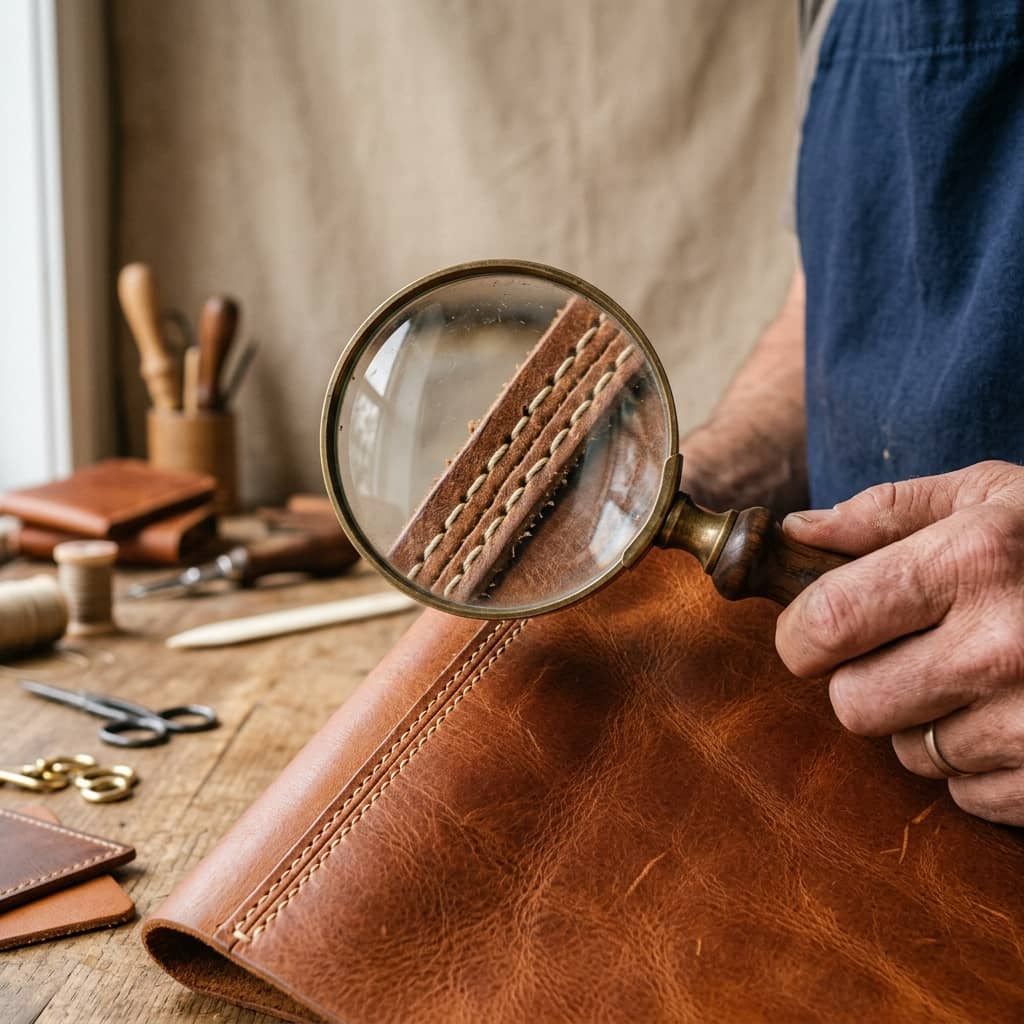
- Stitching: Look for even, straight stitches, a consistent stitch length and secure start and end points. Loose or skipped stitches are a red flag.
- Edge finishing: Edges should be smooth, sealed and evenly painted or burnished, without cracks or peeling.
- Symmetry and shape: Both sides of a bag or wallet should match, and the product should hold its shape.
- Lining and interior: Check the fabric quality, pockets and stitching inside.
- Hardware: Test zips, buckles, snaps and clasps repeatedly. They should move smoothly and feel solid.
- Colour consistency: Compare panels and parts to check that the colour matches throughout.
- Smell, cleanliness and finishing: Look for glue marks, uneven cutting and stray threads.
Step 5: Compare the Bulk Production Sample to the Approved Sample
Always approve a pre-production sample first. Then, before bulk production is shipped, compare the bulk output against it. Check material, colour, size, stitching, hardware and branding. If the bulk pieces differ, raise it before you accept the order. For large orders, consider asking for a production sample or a few random pieces from the bulk batch.
Step 6: Ask for Lab Tests When Needed
For large or export orders, or when you need proof of quality, you can request laboratory testing. Common tests include:
- Material identification: To confirm that the material is real leather
- Colour fastness: To check that colour does not rub off or fade easily
- Tear and tensile strength: To check durability
- Flex resistance: To see how the finish handles repeated bending
- Chemical compliance: To meet requirements of certain markets, such as restricted substances rules (REACH)
Step 7: Plan a Pre-Shipment Inspection (AQL)
Before final payment and shipping, check the finished goods. You can do this yourself, send a representative, or use a third-party inspection company. A common approach is to inspect a random sample of the batch using an agreed Acceptance Quality Limit (AQL), which sets how many defects are acceptable. Agree on the inspection method and defect limits with your supplier before production begins, so there is no argument later.
Quick Checklist: Genuine Leather Quality Before Bulk Buying
| Quality Checkpoint | Verification Standard |
|---|---|
| Leather type and grade | Confirmed in writing (e.g. Full-grain, Top-grain) |
| Sensory evaluation | Grain pores natural, edges fibrous, natural smell verified |
| Hands-on tests | Water absorption, cloth rub, and flex tests passed |
| Stitching and edge finishing | Straight stitches, secure tie-offs, smooth burnished edges |
| Hardware & Components | Smooth zips, sturdy buckles, no loose snaps |
| Pre-production sample | Approved and retained as benchmark reference |
| Pre-shipment inspection | AQL defect limits agreed before production |
Frequently Asked Questions
How can I quickly check if leather is genuine?
Look at the grain and edges, smell the material, feel its flexibility, and check the back. Use simple tests together, and confirm with documents or a lab test for large orders.
Is the water drop test reliable?
It is only an indicator. Finished or treated leather may not absorb water, so use it along with other checks.
What is the best way to check bulk leather quality?
Combine written specifications, sample approval, craftsmanship checks, and a pre-shipment inspection. Add lab tests for large or export orders.
What is AQL in quality inspection?
AQL (Acceptance Quality Limit) is a standard way of deciding how many defects are acceptable in a random sample of a batch. Agree on it with your supplier before production.
What should I do if the bulk order does not match the sample?
Raise it immediately, share photos and details in writing, and refer to your agreed terms on defects and replacements.
Conclusion
Checking genuine leather quality before buying in bulk does not need to be complicated. Get the specifications in writing, test the sample, inspect the craftsmanship, compare bulk output with the approved sample and plan an inspection before shipping. These steps help you avoid costly mistakes and build long-term trust with your customers.
Looking for premium genuine leather handbags, slim essentials or corporate gifting products? Contact CORRISTA today for catalogues, samples and bulk pricing.
Enjoyed this read? Subscribe.
Discover deep-dive tannery metrics, wholesale supply updates, and luxury craftsmanship guides directly from our master workshop in Agra.
Written by Chandan Kumar
Director of Tannery & Leathercraft
Updated
Oct 15, 2026
Related articles

Formal vs. Casual Leather Belts: A Buyer’s Guide to Building the Right Collection

Leather Belt Quality Checklist: What Wholesale Buyers Should Inspect
